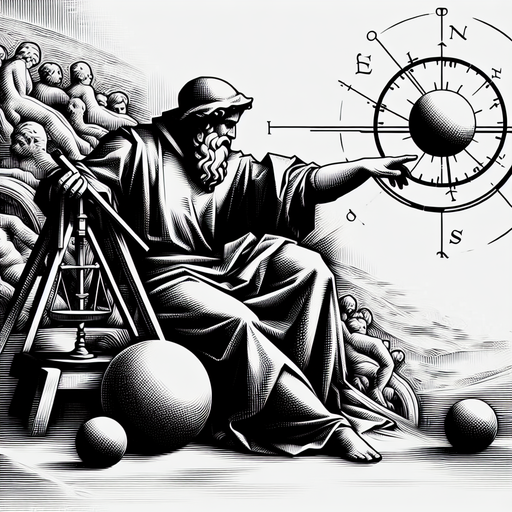
In late-Roman Alexandria, ideas were argued as fiercely as politics. At the center stood Hypatia, one of the earliest well-documented women to teach mathematics and astronomy in public. She was a philosopher, lecturer, and geometer who could turn the motion of stars into something students could reason through. Later tradition linked her to the astrolabe; whether she built one herself is uncertain, but she clearly taught through instruments.
Hypatia lived around c. 355-415 CE and was trained by her father, the mathematician Theon. She later led a Neoplatonic school and taught both pagan and Christian students, drawing visitors from across the Mediterranean. Much of our direct evidence comes from letters written by her student Synesius of Cyrene, who sought her advice on technical devices, including a planispheric astrolabe and a hydroscope. Those letters matter because they show her authority was practical as well as philosophical. Students did not only ask what to believe; they asked how to measure.
The astrolabe compressed the sky into a flat, calculable model: engraved coordinate plates, a rotating star map, and a sighting rule. With it, users could estimate time, latitude, and stellar risings. Hypatia’s world also ran through texts. She is associated with mathematical commentaries in the Ptolemaic tradition, helping preserve and clarify methods of computation for later readers. Instrument work and textual work reinforced each other. In her teaching orbit, claims about the heavens had to survive geometry, not just rhetoric.
Her murder in 415 CE is often framed as science versus religion, but the historical picture is more entangled. Alexandria was split by power struggles between civic and ecclesiastical factions, and Hypatia, as a prominent intellectual tied to elite networks, became a target inside that conflict. A Christian mob killed her, and later generations turned the event into a warning about what happens when factional power overwhelms argument. Her legacy is that she modeled a durable standard: knowledge should be testable, teachable, and open to scrutiny, whoever makes the claim.
Craving more? Check out the source behind this Brain Snack!