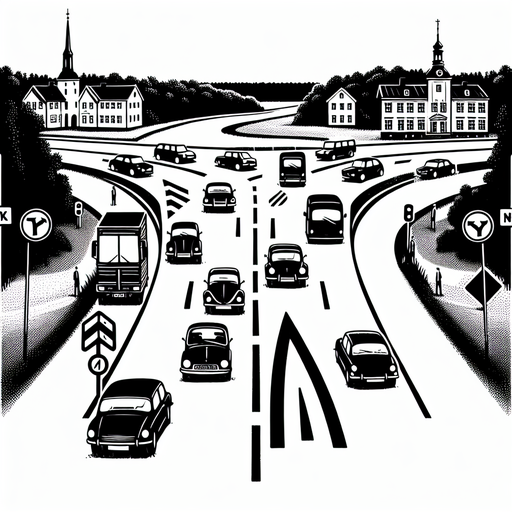
France has more roundabouts than any other country in the world, after expanding them massively in the late twentieth century. This was a bet on road safety that paid off and made sense for the country that first experimented with them in Paris in the early twentieth century, when new car traffic mixed with horse-drawn carriages in chaotic intersections where twelve avenues could merge at once.
The problem was that the rules were unclear. Everyone pushed forward at the same time and nobody yielded. By the 1920s the French government tried to regulate priority but never established a consistent standard. The birthplace of the roundabout was also the first to lose confidence in it. Through the mid-1900s, as cars multiplied, France avoided building new circles and even dismantled some old ones. The original concept seemed doomed.
Then, in the 1960s, British engineer Frank Blackmore introduced a radical rule: cars entering must yield to those already circulating. This single idea unlocked the efficiency the French design had never achieved. France watched skeptically at first, then reluctantly tested the rule at home. In 1984 France made a decisive move by adopting the British priority rule nationwide, triggering one of the fastest transformations in traffic engineering in Europe.
Today France has more roundabouts than any other country, preventing hundreds of traffic deaths. France created the roundabout, watched it fail, learned from others, then reclaimed it on an even larger scale. In the end, the father of the roundabout became its most devoted caretaker, showing that good ideas sometimes need to mature elsewhere before coming back to lead the way.
Craving more? Check out the source behind this Brain Snack!