Entangled Time
How Two Physicists Reframed Time Itself as a Quantum Illusion
Time feels inescapable. We live by clocks, calendars, and the steady tick of cause and effect. Yet in the quantum view of the universe, time is strangely absent. The equations describing all of reality, the so-called Wheeler–DeWitt equation,don’t include it at all. To physics at its most fundamental, the universe simply is. In 1983, Don Page and William Wootters dared to ask: if time isn’t written into the laws of nature, where does it come from?
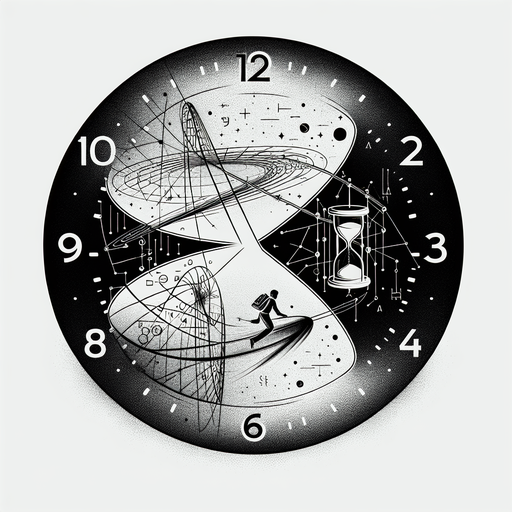
Their answer was radical: time is an illusion born of quantum entanglement. They imagined the universe as a timeless whole. But if you split it into two parts, a “clock” and a “system”, then correlations between the two can make it look like things evolve. The clock’s ticks don’t measure an external flow; they merely mark how one quantum system becomes linked to another. To an outside observer, nothing changes. From within, it feels like time is marching forward.
This idea flipped the role of entanglement. Until then, it was mostly known as Einstein’s dreaded “spooky action at a distance,” a way of linking particles across space. Page and Wootters showed it could also link events across what we call time. In effect, all equal clock readings belong to the same “history.” What we experience as change is simply the unfolding of entangled states, stitched into a story by the quantum fabric itself.
For decades the proposal sat on the fringe, until experiments with entangled photons in the 2010s gave it real weight: globally static, locally dynamic, just as Page and Wootters predicted. If true, it means our experience of time is not fundamental, but relational, arising from the quantum connections that bind us to everything else. Each tick of the clock is not a step forward, but a reminder: time may be less a river, and more a trick of perspective.
Craving more? Check out the source behind this Brain Snack!